It can hold a certain type of data.Tuple,char,string etc.A stack is a linear data structure that follows the Last In, First Out (LIFO) principle. This means that the last element added to the stack will be the first one to be removed. Stacks are analogous to a stack of plates where you can only add or remove plates from the top. Common operations in a stack include:
Push: Adding an element to the top of the stack.
Pop: Removing the top element from the stack.
Peek/Top: Retrieving the top element without removing it. ## implement ==>
1)arrays
2)linked list
3)stack-->stack <int> st
4)Using Queue ## operations ==>
push()
pop()
top
size
push(2)
push(3)
push(4)
push(1) --->[2,3,4,1]
pop()--->[2,3,4]
top()-->4
top()-->4
pop()-->[2,3]
push(5)-->[2,3,5]
top()-->5
size()-->3 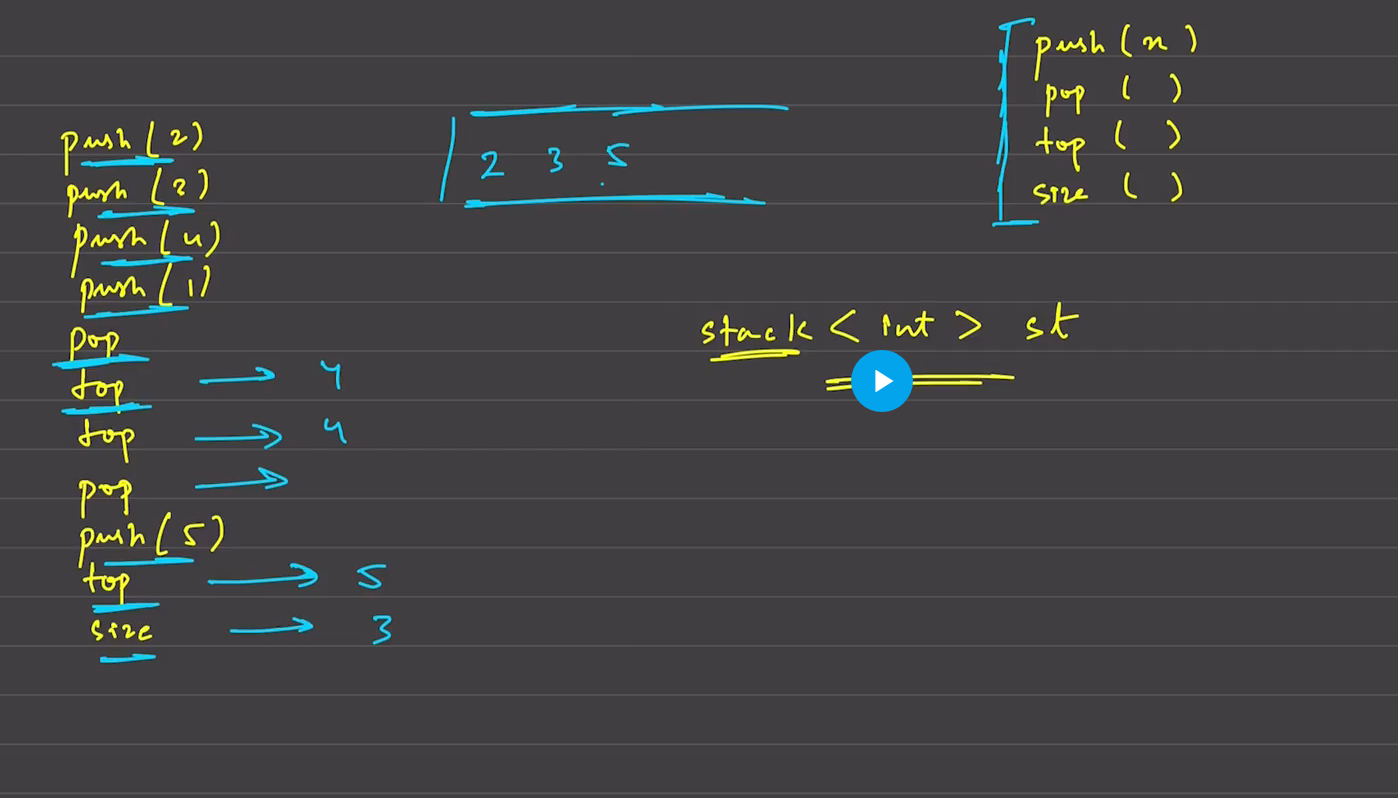 --- ## Stack using array ==>
size is fixed in this
know the size first :int st[10]
top=-1
push==>top increments index
pop==>top decrements index
size==>top+1
top==>st[top]
best if u use a class
pseudo code==>
    class stImpl{
        top=-1;int st[10];
        push(n){------------>TC=O(1),SC=O(N)
            if(top>=10){
                cout<<"stackoverflow";
            }
            else{
                top=top+1;
                st[top]=n;
            }
        }
        top(){------------>TC=O(1)
            if(top==-1){
                return -1
            }
            else{
                return st[top];
            }
        }
        pop(){------------>TC=O(1)
            if(top==-1){
                cout<<"nothing to delete";
            }
            else{
                top=top-1;

            }
        }
        size(){------------>TC=O(1)
            return top+1;
        }

    }
size will be dynamic in nature
top=NULL;
push()==>create node with num, next =>NULL,top points to 1st node
2push()=>create node with num, 1stpush next==>2nd node, n 2nd node next=>NULL;top=>2nd node
pop==>
    temp=top;
    top=top->next;
    delete temp;
Pseudo Code==>
    class stUsingll{ ===>TC=O(1),SC=O(N)
        Node * top;//NUll pointer
        size=0;

        push(n){
            Node * temp = new Node(n);
            temp->next= top;
            top=temp;
            size +=1;
        }
        pop(){
            temp=top;
            top=top->next;
            delete temp;
            size -=1;
        }
        size(){
            return size;
        }
    }